Bandera de Países del estado Macedonia
Bandera de Macedonia - Bandera del país
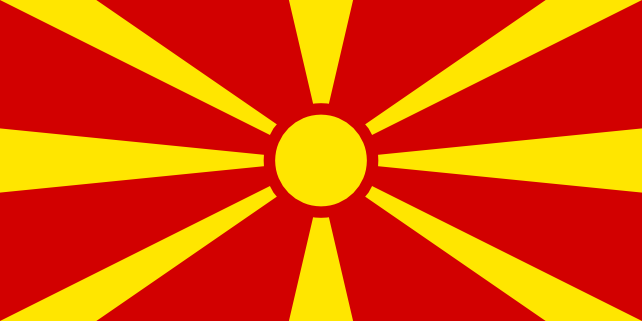
Flag está disponible en las resoluciones
Icono 88x44

Icono 32x16

Macedonia
Macedonia, officially known as the Republic of North Macedonia, is a landlocked country located in the heart of the Balkan Peninsula, a region steeped in history and rich in cultural heritage. Its strategic position has made it a crossroads of civilizations for millennia, influencing its diverse population, intricate history, and unique cultural tapestry. The country is characterized by its stunning natural landscapes, dominated by mountains, valleys, and crystal-clear lakes, offering a picturesque backdrop to its ancient cities and charming villages.
The population of North Macedonia is a vibrant mosaic of ethnicities and religions, reflecting its complex past. The majority of the population identifies as ethnic Macedonians, speaking the Macedonian language, a South Slavic tongue. However, a significant Albanian minority constitutes the largest ethnic group after Macedonians, with their own distinct language and cultural traditions. Other minority groups include Turks, Roma, Serbs, Bosniaks, and Vlachs, each contributing to the countrys multicultural character. This diversity, while a source of richness, has also been a focal point of historical tensions and political complexities within the nation and its neighbors. The religious landscape is predominantly Orthodox Christian, with a substantial Muslim population, primarily among the Albanian and Turkish communities. This religious diversity has, for the most part, coexisted peacefully, though historical events have sometimes tested these interfaith relations. The demographic trends in North Macedonia have been influenced by emigration, particularly to Western Europe and North America, seeking better economic opportunities. This has led to a gradual decline in the overall population, with a significant portion of the population being younger, though the aging of the population is also a growing concern. The countrys cultural expressions are deeply rooted in its history, with traditional music, dance, and crafts playing a vital role in preserving its identity. Festivals and celebrations often blend religious and folk traditions, offering visitors a glimpse into the soul of the nation.
The history of Macedonia is a long and tumultuous narrative, stretching back to antiquity. The region was inhabited by various Illyrian and Thracian tribes before the emergence of the ancient Kingdom of Macedon, famously led by Philip II and his son, Alexander the Great, who forged one of the largest empires of the ancient world. The legacy of this Hellenistic period, though debated and often claimed by neighboring countries, is an undeniable part of the historical consciousness of the region. Following the Roman conquest, Macedonia became a significant province of the Roman Empire, and later the Byzantine Empire, witnessing the spread of Christianity and the development of Slavic settlements. The arrival of the Slavs in the 6th and 7th centuries marked a pivotal moment, shaping the linguistic and cultural landscape of the region. During the medieval period, the First Bulgarian Empire and later the Second Bulgarian Empire exerted significant influence, and the region played a role in the struggles between various Balkan states. The Ottoman Empire conquered the Balkans in the 14th century, and Macedonia remained under Ottoman rule for over five centuries. This long period of foreign domination profoundly impacted the social, economic, and cultural development of the region, fostering a strong sense of national identity and a desire for independence. The late 19th and early 20th centuries saw the rise of Macedonian nationalism and the struggle for liberation from Ottoman rule, culminating in the Balkan Wars and World War I. Following these conflicts, the territory of geographical Macedonia was divided among its neighbors: Serbia, Greece, and Bulgaria. The Macedonian people found themselves dispersed and often subjected to assimilation policies. During the socialist era of Yugoslavia, the Socialist Republic of Macedonia was established as a constituent republic, enjoying a period of relative peace and development, and solidifying its distinct identity. The dissolution of Yugoslavia in the early 1990s led to the peaceful secession of the Republic of Macedonia, which declared its independence in 1991. However, its path to international recognition and integration was complicated by the dispute over its name with Greece, a protracted issue that significantly hindered its aspirations for NATO and European Union membership. This dispute was finally resolved in 2018 with the Prespa Agreement, leading to the countrys renaming to the Republic of North Macedonia.
Geographically, North Macedonia is a landlocked country situated in the southern Balkans, bordered by Kosovo to the northwest, Serbia to the north, Bulgaria to the east, Greece to the south, and Albania to the west. The landscape is predominantly mountainous, with the Šar Mountains, Osogovo Mountains, and the Baba Mountains forming significant ranges. These mountains are characterized by rugged peaks, deep valleys, and lush forests, offering abundant opportunities for hiking, mountaineering, and skiing. The country is also blessed with numerous rivers, the most important being the Vardar River, which flows through the heart of the country, draining into the Aegean Sea. Other notable rivers include the Strumica, Bregalnica, and Pchinja. However, the most striking geographical feature is its network of lakes, with Lake Ohrid being the crown jewel. This ancient tectonic lake, shared with Albania, is one of Europes deepest and oldest, renowned for its exceptional biodiversity and crystal-clear waters. Lake Ohrid and the surrounding town of Ohrid are recognized as a UNESCO World Heritage site, attracting visitors from around the globe. The countrys climate is continental, with warm summers and cold, snowy winters, particularly in the mountainous regions. The southern parts of the country experience a more Mediterranean influence, with milder winters and hotter summers. This diverse geography provides a rich habitat for a variety of flora and fauna, including endemic species found in the pristine natural environments.
The economy of North Macedonia has been transitioning from a centrally planned system to a market-oriented one since its independence. The industrial sector remains a significant contributor, with key industries including mining, metallurgy, food processing, textiles, and pharmaceuticals. The country possesses considerable mineral resources, such as lead, zinc, copper, and iron ore, which are exploited by mining and smelting operations. The textile and garment industry has a long tradition and continues to be an important employer, often serving international markets. Food processing, leveraging the countrys agricultural output, is also a crucial sector. However, the economy faces challenges, including high unemployment rates, a relatively low average wage compared to other European countries, and the need for further structural reforms to attract foreign investment and boost competitiveness. The agricultural sector is also vital, with the cultivation of tobacco, wine grapes, fruits, and vegetables playing a significant role in rural economies. The country is actively seeking to diversify its economic base and foster growth in sectors such as information technology and renewable energy. The government has been implementing policies aimed at improving the business environment, combating corruption, and aligning its economic regulations with European Union standards, as part of its long-term goal of EU membership.
North Macedonia is a treasure trove of tourist attractions, offering a compelling blend of history, culture, and natural beauty. The city of Ohrid, perched on the shores of the eponymous lake, is undoubtedly the most famous destination. Its ancient churches, monasteries, and the impressive Samuels Fortress stand as testaments to its rich past, earning it the moniker Jerusalem of the Balkans. The medieval architecture, cobblestone streets, and the vibrant atmosphere of the old town create an unforgettable experience. Skopje, the capital city, is a fascinating juxtaposition of old and new. The Old Bazaar (Čaršija), one of the largest and best-preserved in the Balkans, is a labyrinth of narrow streets, bustling markets, and historic mosques and hammams. In contrast, the city center has undergone significant modernization with the Skopje 2014 project, featuring grand monuments, neoclassical buildings, and numerous statues, which has sparked both admiration and controversy. Beyond these major cities, the country offers numerous other points of interest. The Matka Canyon, a breathtaking gorge near Skopje, is ideal for kayaking, hiking, and exploring ancient cave churches. The national parks, such as Mavrovo and Galičica, provide stunning mountain scenery, pristine lakes, and opportunities for outdoor activities. The countrys numerous monasteries, scattered throughout the landscape, offer glimpses into its spiritual heritage and artistic traditions, many adorned with exquisite frescoes. The culinary scene is also a significant attraction, with hearty traditional dishes featuring grilled meats, fresh vegetables, and flavorful pastries, often accompanied by local wines and rakija. North Macedonias hospitality and relatively affordable prices make it an increasingly attractive destination for travelers seeking authentic Balkan experiences away from mass tourism. The ongoing efforts to develop its tourism infrastructure and promote its cultural and natural assets promise a bright future for this captivating Balkan nation.
Información sobre Macedonia
La información proviene de la publicación CIA The World Factbook.
Traducción automática de texto, los errores excusa, por favor!
País Macedonia está situado en una ubicación / continente Europa. Macedonia tiene una superficie de 25 713 km2 y 2 082 370 residentes. El punto más alto tiene una altura 2 764 sobre el nivel del mar. y se llama Golem Korab (Maja e Korabit). El punto más bajo se encuentra a nivel de 50 sobre el nivel del mar y que le da nombre Río Vardar. Sistema de gobierno es República y la fecha de la independencia 08 de septiembre 1991. La ciudad capital es Skopje. Macedonia tiene la abreviatura internacional MK.
Macedonia - economía
Total del producto interno bruto (PIB) es 21 620 000 000 $. Total del producto interno bruto per cápita en paridad de poder adquisitivo es 10 500 $. PIB crece 3.00 % Anual. La inflación (índice de precios al consumidor) es igual a 3.90 % un ano. Macedonia haber 942 400 población en edad laboral (de una población total 2 082 370 personas). El desempleo está en 31.40 %. Macedonia emitido 6.90 % Del PIB a la asistencia sanitaria y 6,00 % Del PIB para el ejército. La deuda pública del país es 28.20 % del PIB. El monto total de la deuda externa es 6 609 000 000 USD.
Macedonia - demografía
Como se sugirió anteriormente, Macedonia haber 2 082 370 pueblo. Crecimiento de la población está en la cantidad 0.24 % Por ano. Número de ninos nacidos por cada 1000 habitantes por ano es 11.80.Toda madre tiene promedio 1.59 ninos. La tasa de mortalidad infantil es 8.32 y la mortalidad derivada de la maternidad 10.00 muertes por cada 100.000 nacidos. Promedio de esperanza de vida estimada hace 75.36 anos. La mortalidad es 8.95 personas por cada 1000 habitantes por ano.
Macedonia - transporte y telecomunicaciones
Macedonia haber 13 736 kilómetros de carreteras, 699 km de líneas de ferrocarril 14 aeropuertos.
Número de teléfonos móviles activos (tarjeta SIM) en el país Macedonia es 2 257 000. Número de líneas activas de telefonía fija es 413 500. Macedonia haber 1 057 000 los usuarios de internet, que tienen la disposición 62 718 conexiones a Internet. Macedonia se le ha asignado un primer dominio Elija rango .mk.
Macedonia - energéticos
Macedonia consume un ano 9 024 000 000 kWh de electricidad. Producción anual de electricidad es 6 390 000 000 kWh en las centrales eléctricas con una capacidad eléctrica instalada 1 540 000 kW. Macedonia exportaciones 0 kWh y las importaciones 2 634 000 000 kWh de electricidad al ano Energy mix de generación de energía es el siguiente: combustibles fósiles: 65.7 %, energía nuclear: 0 %, renovable: 0.0 %, energía hidroeléctrica: 34.3 %.
Palabras clave: Banderas nacionales, Bandera, Macedonia, Transporte y telecomunicaciones, Bandera de Macedonia, información, Países del mundo, Energéticos, Demografía, Estados de bandera, Todas las banderas, Europa, Banderas de países del mundo, Banderas del mundo, Banderas de países, Economía